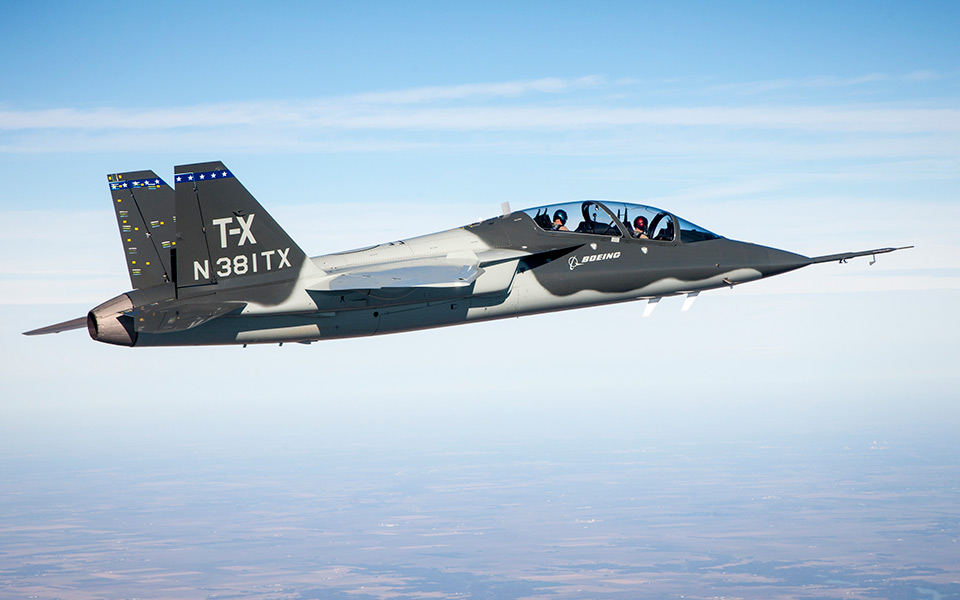
Boeing has unveiled the new T-X trainer jet design, an all-new advanced pilot training system designed specifically for the U.S. Air Force training missions.
The T-X trainer has twin canted vertical tails similar to the F-22, F-35 and F/A-18. To keep costs down the aircraft features a single engine with stadium seating. The trainer has an advanced cockpit with embedded training. The system also includes state-of-the-art ground-based training and a maintenance-friendly design for long-term supportability.
The Air Force needs a replacement for its T-38 Talon trainer aircraft which were first produced by Northrop in 1959.
Boeing has already built two and is ready to build more for the Air Force training program. The Air Force hopes to buy 350 new trainer jets with initial operating capability planned for 2024.
Photos courtesy of Boeing
Cool and Amazing brings together information about technology, gadgets, design, art and anything else affecting our everyday life. We are inspired by future technology and the occasional amazing item that might impact our daily life.
Showing posts with label fighter. Show all posts
Feb 22, 2017
Sep 2, 2016
McDonnell Douglas F-15 Eagle
The McDonnell Douglas F-15 Eagle has long been considered one of the most successful dog-fighting aircraft in US history with an undefeated air-to-air combat record with more than 100 aerial combat victories, according to Boeing.
The entire F-15 fleet was due to be replaced with the fifth-generation F-22 Raptor but only 188 of the 749 F-22s purchased by the Pentagon were ever produced.
Now a $12 billion upgrade is underway for the US Air Force’s 1980s-era F-15 fighters. The upgrade will cover 435 F-15's and will include new radar technology, updated mission computer systems and modern communication tools. In addition, an advanced infrared search and track capability and electronic warfare defenses will be incorporated so the F-15's can work in concert with more advanced aircraft including the F-22 Raptor and F-35 Lightning II.
The upgrades will allow the F-15 Eagle to carry up to 16 missiles rather than the standard 8. The upgrades will extend the F-15 lifespan through 2040. The F-15 Eagle has a maximum speed at high altitude of Mach 2.5+ (1,650+ mph, 2,665+ km/h) and Mach 1.2 (900 mph, 1,450 km/h) ay low altitude.
The entire F-15 fleet was due to be replaced with the fifth-generation F-22 Raptor but only 188 of the 749 F-22s purchased by the Pentagon were ever produced.
Now a $12 billion upgrade is underway for the US Air Force’s 1980s-era F-15 fighters. The upgrade will cover 435 F-15's and will include new radar technology, updated mission computer systems and modern communication tools. In addition, an advanced infrared search and track capability and electronic warfare defenses will be incorporated so the F-15's can work in concert with more advanced aircraft including the F-22 Raptor and F-35 Lightning II.
The upgrades will allow the F-15 Eagle to carry up to 16 missiles rather than the standard 8. The upgrades will extend the F-15 lifespan through 2040. The F-15 Eagle has a maximum speed at high altitude of Mach 2.5+ (1,650+ mph, 2,665+ km/h) and Mach 1.2 (900 mph, 1,450 km/h) ay low altitude.
May 6, 2016
Sukhoi PAK FA
Russia has been working steadily toward its own version of a fifth-generation aircraft with the Sukhoi PAK FA but industry insiders are saying the airplane is having developmental issues. The Russian Defense Ministry have openly stated the PAK FA will be stealthy, supermaneuverable and have supercruise capability but the lack of evolutionary technology aboard the plane, the engines are the same as those aboard Russia's 4th generation Su-35, and the sharing of many of the same on-board systems with the Su-35 also put the fifth-generation fighter designation in question. The aircraft is intended to be the successor to the MiG-29 and Su-27 in the Russian Air Force.
Reports have surfaced of problems with the plane's engine performance, the reliability of its AESA radar, and of poor stealth engineering. Compared to the US Air Force F-22 Raptor or the F-35 Lightning II, the PAK FA is significantly less stealthy than the US fighters. The F-22 Raptor stealth systems holds a huge advantage over the Russian jet.
The PAK FA is designed to be a fast, high flying and stealthy air superiority fighter and it might hold a slight agility advantage over the F-22 with its three-dimensional thrust vectoring engines but the F-22 Raptor probably has the edge in terms of sensor and weapon integration as well as a much more advanced stealth configuration.
The PAK FA has a maximum speed at altitude of Mach 2.3 (2,440 km/h, 1,520 mph) and can Supercruise at Mach 1.6 (1,700 km/h, 1,060 mph)
Reports have surfaced of problems with the plane's engine performance, the reliability of its AESA radar, and of poor stealth engineering. Compared to the US Air Force F-22 Raptor or the F-35 Lightning II, the PAK FA is significantly less stealthy than the US fighters. The F-22 Raptor stealth systems holds a huge advantage over the Russian jet.
The PAK FA is designed to be a fast, high flying and stealthy air superiority fighter and it might hold a slight agility advantage over the F-22 with its three-dimensional thrust vectoring engines but the F-22 Raptor probably has the edge in terms of sensor and weapon integration as well as a much more advanced stealth configuration.
The PAK FA has a maximum speed at altitude of Mach 2.3 (2,440 km/h, 1,520 mph) and can Supercruise at Mach 1.6 (1,700 km/h, 1,060 mph)
Labels:
fighter,
planes,
Russian,
Sukhoi PAK FA,
tech
Apr 11, 2016
Dassault Mirage F1
The Dassault Mirage F1 attack aircraft was designed and built as a successor to the Mirage III family.
The Mirage F1 has been used as a light multipurpose fighter and was exported to about a dozen nations. More than 720 F1's were produced.
Although the F1 has a smaller wingspan than the Mirage III, the F1 nevertheless proved to be superior. It can carry up to 43% more fuel, has a shorter take-off run and better maneuverability.
The Mirage F1 served as the main interceptor of the French Air Force until the Dassault Mirage 2000 entered service.
The Mirage F1 has been used as a light multipurpose fighter and was exported to about a dozen nations. More than 720 F1's were produced.
Although the F1 has a smaller wingspan than the Mirage III, the F1 nevertheless proved to be superior. It can carry up to 43% more fuel, has a shorter take-off run and better maneuverability.
The Mirage F1 served as the main interceptor of the French Air Force until the Dassault Mirage 2000 entered service.
A-10 Warthog
The Air Force is looking to replace the A-10 Warthog and is reviewing the future of its close air-support aircraft. The Fairchild Republic A-10 Thunderbolt II first flew in 1975 and is the only airplane in the Air Force specifically designed for close air support.
The A-10 is armed with a powerful 30 mm, seven-barrel Gatling gun, which can fire depleted uranium bullets at 3,900 rounds per minute and can carry up to 16,000 pounds of bombs and missiles.
The F-35 was supposed to assume the close air support role once the A-10 was retired but U.S. Air Force officials are now showing signs that they are rethinking that strategy. Another possibility is for the Air Force to replace the A-10 with the Super Tucano, called the A-29 by the Air Force, made by Brazilian aviation firm Embraer.
The A-10 is armed with a powerful 30 mm, seven-barrel Gatling gun, which can fire depleted uranium bullets at 3,900 rounds per minute and can carry up to 16,000 pounds of bombs and missiles.
The F-35 was supposed to assume the close air support role once the A-10 was retired but U.S. Air Force officials are now showing signs that they are rethinking that strategy. Another possibility is for the Air Force to replace the A-10 with the Super Tucano, called the A-29 by the Air Force, made by Brazilian aviation firm Embraer.
Future fighter Jets
As the threat environment continues to proliferate over the next few years the US Air Force will explore options for maintaining air superiority in the future battle field.
With Russia and China continuing to close the capability gap, building long-range missiles, anti-satellite and anti-aircraft weapons designed to foil US forces’ ability to penetrate, the Air Force must find new ways to dominate the air. The Air Force will need to work to find the most effective combination of speed and maneuverability, the right level of stealth and low-observability.
Boeing offered a glimpse of its next generation F-X fighter intended for the U.S. Navy and Air Force. The F-X fighter will fly at faster speeds than the F-35 and be capable of supercruising. Supercruising is sustained supersonic flight without the use of afterburners.
With Russia and China continuing to close the capability gap, building long-range missiles, anti-satellite and anti-aircraft weapons designed to foil US forces’ ability to penetrate, the Air Force must find new ways to dominate the air. The Air Force will need to work to find the most effective combination of speed and maneuverability, the right level of stealth and low-observability.
Boeing offered a glimpse of its next generation F-X fighter intended for the U.S. Navy and Air Force. The F-X fighter will fly at faster speeds than the F-35 and be capable of supercruising. Supercruising is sustained supersonic flight without the use of afterburners.
Labels:
air superiority,
aircraft,
boeing,
F-X fighter,
fighter,
planes,
tech
Subscribe to:
Posts (Atom)


