Cool and Amazing brings together information about technology, gadgets, design, art and anything else affecting our everyday life.
We are inspired by future technology and the occasional amazing item that might impact our daily life.
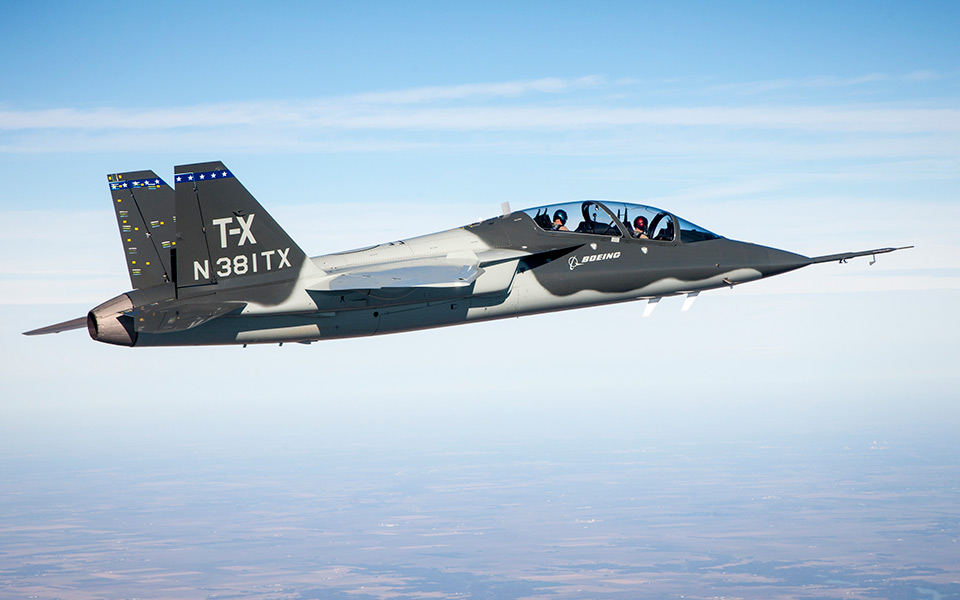
Boeing has unveiled the new T-X trainer jet design, an all-new advanced pilot training system designed specifically for the U.S. Air Force training missions.
The T-X trainer has twin canted vertical tails similar to the F-22, F-35 and F/A-18. To keep costs down the aircraft features a single engine with stadium seating. The trainer has an advanced cockpit with embedded training. The system also includes state-of-the-art ground-based training and a maintenance-friendly design for long-term supportability.
The Air Force needs a replacement for its T-38 Talon trainer aircraft which were first produced by Northrop in 1959.
Boeing has already built two and is ready to build more for the Air Force training program. The Air Force hopes to buy 350 new trainer jets with initial operating capability planned for 2024.
The Defense Advanced Research Projects Agency (DARPA) is pursuing, through the "VTOL X-Plane" program, an aeronautical leap forward in vertical take-off, hover and flight. The future X-plane must be able to act like an helicopter but at the same time be able to execute high-speed flight like an airplane. Helicopters can take off and land almost anywhere and hover, but they can't fly very fast. Fixed-wing planes can fly fast but can’t hover. The tiltrotor V-22 Osprey, which has two large wingtip rotors that tilt upward to take off like a helicopter and then rotates them forward to fly like an airplane, is the only operational aircraft that comes close. DARPA wants a technology demonstrator that will fly at “sustained speeds” of 345 to 460 miles per hour.
Boeing's concept
Four companies have offered designs to build this plane-of-the-future technology demonstrator. The designs include new types of tiltrotors, compound helicopters with innovative mechanisms for vertical and horizontal thrust and innovative systems of electrical fans. The fans are powered by distributed electric systems using conventional gas turbine engines which in turn produce electricity for the powerful fans that will propel the vehicle vertically and through the air. DARPA will choose one company to build the VTOL X-Plane and flight test it in 2017-18
Engineers at GE Aviation just assembled the world’s largest jet engine and put it on a test stand at the company’s test site for jet engines located in the woods near Peebles, Ohio. GE also built the first U.S. jet engine in 1942. The brand new GE9X front fan spans a full 11 feet in diameter (3.35 meters), a world record and is a winner in several disciplines.
GE is using additive manufacturing, known as 3D printing, to essentially print parts from the ground up. The engine has 3D printed fuel nozzles and the most extensive use of parts made from lightweight and ultra heat-resistant materials called ceramic matrix composites (CMCs). The technology allows engineers to design complex internal shapes that were previously impossible to achieve.
The material used inside the combustor and the turbine built out of CMCs operates in temperatures as high as 2,400 degrees Fahrenheit. The hotter the engine runs, the more efficient it is in reducing fuel burn and emissions. The GE9X is designed to generate 100,000 pounds of thrust but the world record belongs to the engine’s predecessor, the GE90-115B, which generated 127,500 pounds of thrust. For comparison, one space shuttle main engine produces 375,000 pounds.
GE has been testing the new design for the GE9X carbon fiber blades on a scaled-down
testing rig at Boeing. Image credit: GE Aviation
GE Aviation will be the exclusive engine maker for the new Boeing 777X, the next-generation version of the 777. The engine is scheduled to enter service by the end of the decade.
The US Navy and the Air Force will need better stealth technology to mask aircraft and ships from enemy radars. Both services are conducting early developmental work into the next generation of fighters that will supplement or replace the F-22 Raptor and the F-35 Lightning II. The Air Force’s F-X fighter will need better and more advanced stealth than the F-22 currently offers to survive in a future conflict.
Lockheed Martin's F-X concept for a sixth-generation aircraft
The Navy has been slow in adopting stealth relying more on electronic warfare platforms like the Boeing EA-18G Growler. The Lockheed Martin F-35 Lightning II carrier variant is the Navy’s first production carrier stealth fighter. The Navy’s F/A-XX program is scheduled to enter the fleet around 2030 to replace the United States Navy's F/A-18E/F Super Hornet.
Boeing's F/A-XX concept for a sixth-generation aircraft
The Boeing B-52 Stratofortress has been operated by the United States Air Force since 1955. The airplane has completed sixty years of continuous service with its original operator in 2015. After being upgraded between 2013 and 2015, it is expected to serve into the 2040's.
The B-52 is easily recognized by the eight engines paired in pods and suspended by four pylons beneath and forward of the wings leading edge.
The B-52 is capable of carrying up to 70,000 pounds (32,000 kg) of weapons and has a typical combat range of more than 8,800 miles (14,080 km) with aerial refueling.
As the threat environment continues to proliferate over the next few years the US Air Force will explore options for maintaining air superiority in the future battle field.
With Russia and China continuing to close the capability gap, building long-range missiles, anti-satellite and anti-aircraft weapons designed to foil US forces’ ability to penetrate, the Air Force must find new ways to dominate the air. The Air Force will need to work to find the most effective combination of speed and maneuverability, the right level of stealth and low-observability.
Boeing offered a glimpse of its next generation F-X fighter intended for the U.S. Navy and Air Force. The F-X fighter will fly at faster speeds than the F-35 and be capable of supercruising. Supercruising is sustained supersonic flight without the use of afterburners.